Sampoerna University Students Secure First Place and Gold Medal at International Walisongo Science Competition with AI-Powered Safety Innovation
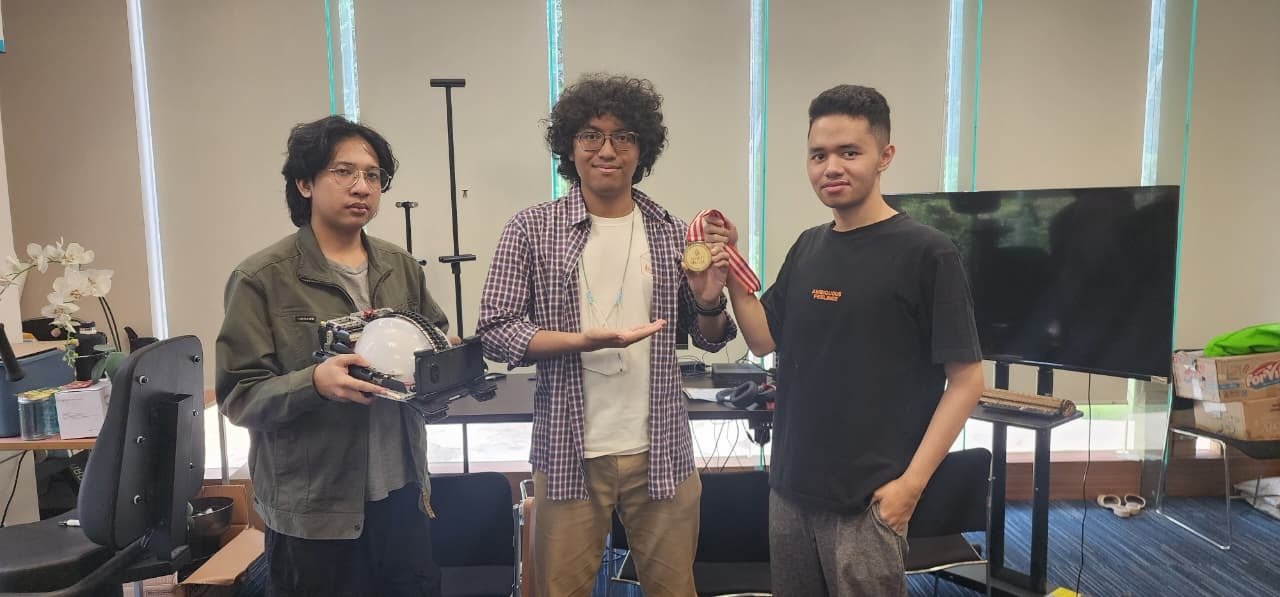
Jakarta, Indonesia — Three students from Sampoerna University, Maheswara Mahirataqi, Rakhansyah, and Miracle Rizaldy Suthelie, have achieved first place in the Scientific Paper: Start-Up Innovation in Information Technology category at the International Walisongo Science Competition, held online on August 1, 2026. The team was awarded a gold medal for their research exploring the application of artificial intelligence to improve workplace safety in the construction and mining sectors.
Under the supervision of faculty member Panji Nursetia Darma, the students developed a scientific paper titled “A Comparative Analysis of AI-Driven Real-Time Hazard Identification and Traditional Safety Oversight Within the Construction and Mining Sectors.” Their work examines the potential of artificial intelligence and computer vision technology as tools to support hazard identification and strengthen existing approaches to workplace safety.
The team’s proposed innovation takes the form of a modified construction helmet equipped with a camera and an AI-powered computer vision system. Designed to detect potential hazards in real time, the system uses a YOLO-based computer vision model that runs on a smartphone’s processor, allowing the proposed solution to operate without requiring an internet connection.
By exploring on-device AI processing, the students aim to address the potential of real-time hazard detection in environments where internet connectivity may be limited or unavailable. Their proposal combines wearable hardware with computer vision technology to explore an alternative approach to supporting safety oversight in high-risk working environments.
“Construction and mining sites are high-risk places, and a supervisor cannot watch every worker at every moment. We wanted to see whether something as ordinary as a smartphone could work as a second pair of eyes mounted on the helmet itself, flagging hazards as they appear,” said Miracle Rizaldy Suthelie. “Our goal was never to replace safety officers or the procedures that are already in place. We see this as a tool that supports them, especially at remote sites where a reliable internet connection is hard to come by.”
The proposed helmet integrates a camera-based detection system with a computer vision model based on YOLO, a family of real-time object detection models. The team’s approach involves running the model on a phone’s processor, reducing reliance on cloud-based processing and enabling the proposed system to function offline.The project reflects the students’ interest in applying artificial intelligence to practical challenges beyond conventional software applications. By combining computer vision, embedded hardware, and startup-oriented product development, the team seeks to explore how emerging technologies can be adapted to real-world occupational safety contexts.
“Writing the paper meant looking at both approaches fairly. We reviewed how safety oversight is usually carried out on site, where manual inspections tend to fall short, and what a real-time detection model like YOLO can realistically achieve on a phone,” said Maheswara Mahirataqi. “The hardest part was being honest about the limitations. Dust, poor lighting, and limited processing power all affect how a model performs in the field, so we had to account for those conditions from the start. Our supervisor, Mr. Panji, helped us keep the paper grounded, and what we had learned in our courses gave us a solid base to build on.”
While the gold medal marks a significant achievement for the team, the students intend to continue developing their proposed innovation. Their plans include optimizing and improving the computer vision model to enhance the system’s performance, as well as refining the helmet’s hardware.
The team also aims to incorporate additional sensors into the helmet to expand its sensing capabilities while minimizing the weight and physical size of the hardware mounted on the helmet. These improvements are intended to support the development of a more practical and efficient prototype.
“The gold medal is encouraging, but we see the paper as a starting point,” said Rakhansyah. “Next, we want to make the model faster and more accurate on a phone’s processor and add sensors that can pick up hazards a camera alone would miss. The hardware on the helmet also has to get smaller and lighter, because workers will not wear something heavy or uncomfortable for a full shift. We hope to turn this proposal into a working prototype that can be tested in real conditions.”
The team’s achievement at the International Walisongo Science Competition demonstrates the students’ engagement with scientific research, artificial intelligence, and technology-driven innovation. Their work also highlights the potential of interdisciplinary collaboration in developing solutions to challenges within the construction and mining sectors.
With plans to further optimize their AI model and improve the proposed hardware, Maheswara Mahirataqi, Rakhansyah, and Miracle Rizaldy Suthelie look forward to continuing their exploration of computer vision and wearable technology for workplace safety.
Sampoerna University congratulates Maheswara Mahirataqi, Rakhansyah, and Miracle Rizaldy Suthelie on their first-place achievement and gold medal at the International Walisongo Science Competition, and wishes the team continued success in their future research and innovation endeavors.